
Is It Real Gold? How to Read Hallmarks on Antique Jewelry
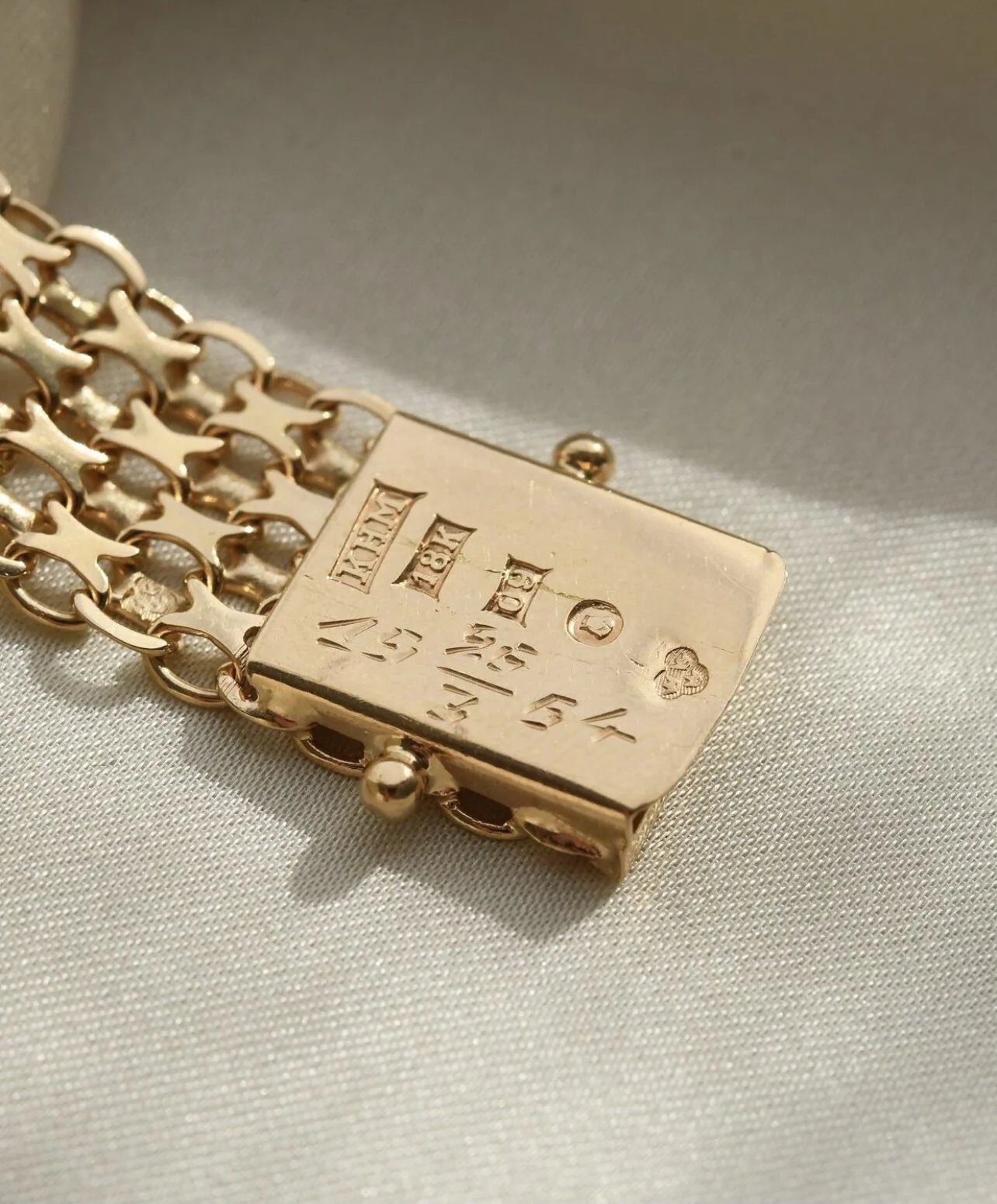
"There is a number stamped inside, does that mean it is real gold?"
It is the most common question I get, and the honest answer is: usually yes, sometimes no, and the absence of a number means almost nothing at all. Here is everything I check, in the order I check it.
What the numbers mean
Modern marks use the millesimal system: parts of gold per thousand.
| Mark | Karat | Gold | Where you see it |
|---|---|---|---|
| 333 | 8k | 33.3% | Germany, Scandinavia, older Continental pieces |
| 375 | 9k | 37.5% | Britain, very common on Victorian and later English gold |
| 417 | 10k | 41.7% | United States |
| 585 | 14k | 58.5% | Everywhere, the workhorse standard |
| 750 | 18k | 75% | Europe, fine jewelry standard |
| 833 / 840 | 20k | 83.3% | Scandinavian and Continental antiques |
| 916 / 917 | 22k | 91.6% | Britain, India, Middle East |
| 999 | 24k | 99.9% | Bullion, rarely wearable jewelry |
Older British pieces often carry the karat number and the millesimal together, for example 18 750 or 9 375. That combination is a good sign: it is the format used from 1854 up to the 1970s.
Marks that mean it is not solid gold
These matter more than the good marks, because this is where people get hurt.
| Mark | What it means |
|---|---|
| GF, 1/20 12K GF | Gold filled. A bonded layer of real gold over base metal. Has some gold, but not scrap-value gold |
| RGP, rolled gold | Rolled gold plate. A thinner bonded layer |
| GP, HGE, GEP | Gold plated or heavy gold electroplate. A microscopic layer |
| Vermeil | Gold plated over sterling silver. Better than plated base metal, still plated |
| 925 | Sterling silver, not gold, even if it looks gold. Very often gilded silver |
Gold filled Victorian and Edwardian pieces can be genuinely lovely and genuinely old. They are just not solid gold, and they should not be priced as if they were.
National hallmarks worth recognising
Not every country stamped a number. Several used pictures, and those pictures are far more informative than a bare "585".
Britain. The gold standard for hallmarking, literally. A full British hallmark has four parts: the sponsor's mark (the maker, in a shaped shield), the standard mark (a crown plus the carat number on older pieces), the assay office town mark, and the date letter. The town marks: a leopard's head for London, an anchor for Birmingham, a rose for Sheffield, a castle for Edinburgh. The date letter changes annually within a font-and-shield cycle, which means a British hallmarked piece can be dated to the exact year. That is unusual and extremely useful. I have written about the English system in more detail in How To Read English Hallmarks.
France. An eagle's head means 18k (750) gold, in use since 1838. A horse's head was used for 18k on larger pieces in an earlier period, and an owl marks imported gold. French marks are tiny and often need a loupe.
Sweden. One of the oldest unbroken systems in Europe, compulsory since 1752, and the reason I can date so much of what passes through my hands to the exact year. A fully marked Swedish piece carries four things: the maker's mark, the fineness (18K is the traditional Swedish gold standard), the town mark, and the date letter. The national control mark is three crowns, and on pieces made in Sweden the crowns sit inside a little three-lobed outline known as the kattfot, or cat's paw. Three crowns in an oval instead means the piece was imported into Sweden. The date letter series has run unbroken since 1759: A through Z, then repeating with a number after it, so A2, A3 and onward. Between the letter and the town mark, a Swedish piece can usually be pinned to a single year, exactly like a British one.
Denmark. Copenhagen used the three towers mark, instituted as the city mark in 1608 and adopted as the national standard mark in 1893, with two digits underneath for the year: towers over "22" means 1922. It was used until 1977, alongside the assay master's (guardein) mark. Danish pieces also frequently carry 826S or 830S for silver, which catches people out on gilded pieces.
Worth saying plainly, because it is the mistake I correct most often: three towers are Danish, three crowns are Swedish. Towers are square and stacked in a row, crowns are round and usually clustered in that little cat's paw. Once you have seen them side by side you will never mix them up again.
Russia. The kokoshnik, a woman's head in profile, marks Imperial and early Soviet era work with the standard in zolotniks, where 56 equals 14k and 72 equals 18k.
United States. There is no compulsory assay office. American jewelry is marked voluntarily, typically 14K, 10K or 585, plus a maker's mark if you are lucky. This means American antique gold is harder to authenticate from marks alone, and easier to fake.
Why unmarked does not mean fake
This is the single most important thing in this article.
- Hallmarking was not compulsory everywhere, and for much of history not compulsory on small or lightweight items.
- Marks were stamped on the part of the piece that gets the most wear, such as the inside of a ring shank, and a century of contact with skin wears them smooth.
- Resizing a ring frequently cuts the marked section straight out.
- Georgian and early Victorian pieces are very often entirely unmarked.
I have handled unmarked 22k Georgian rings and clearly marked "18k" pieces that turned out to be gilded brass. The mark is evidence, not proof.
How to check gold without damaging it
In the order I would actually try them.
- The magnet test. Gold is not magnetic. If a piece jumps to a magnet, there is ferrous metal in it and it is not solid gold. Passing this test proves nothing on its own, since brass and copper are not magnetic either. It is a fast way to rule things out, not to rule them in.
- Weight in the hand. Gold is heavy. 18k gold is roughly twice as dense as silver and about two and a half times as dense as brass. After you have handled a few pieces, a gold-coloured item that feels light is immediately suspicious.
- Look for wear-through. Check edges, the back of a pendant bail, the underside of a ring shank. Plating wears through at the high points and shows a different colour underneath. Solid gold wears down but never changes colour.
- XRF testing at a jeweller. A handheld X-ray fluorescence gun reads the alloy in seconds without touching the piece. It reads the surface, so a thickly gold-filled item can fool it, but it is the best non-destructive test available and most jewellers will do it while you wait.
- Specific gravity testing. Weighing the piece in air and in water gives you its density, which for a stone-free piece is a very good indicator. Stones and hollow construction throw it off.
- Acid testing. Accurate and cheap, and it takes a scrape of metal off your jewelry. On an antique piece I would rather not. If you do it, test in a hidden spot, and never on anything you would be sad to scar.
Two things I would avoid entirely: home electronic gold testers, which are wildly unreliable on antique alloys, and the bite test, which is a myth that has damaged a lot of teeth and a lot of jewelry.
What I do when I buy
For what it is worth, my own routine on a piece I am considering: turn it over, look for marks with a loupe, check the wear points for plating, weigh it in my hand against something I know, look at the construction for the era, and only then think about price. If the marks and the construction disagree, I walk away or I buy it cheaply as a curiosity and say so plainly when I sell it.
That last part matters. Every piece I list says what I know and what I do not. "Unmarked, tests as 18k" is a fair description. "18k" on an untested unmarked piece is not.
Questions people ask
What does 585 mean on jewelry?
585 means the metal is 58.5% pure gold, which is 14 karat. It is the most widely used gold standard in the world for everyday jewelry.
What does 750 mean on a ring?
750 means 75% pure gold, which is 18 karat. It is the standard used for most European fine jewelry.
Is 9k gold real gold?
Yes. 9k (marked 375) is 37.5% gold alloyed with other metals. It is genuinely gold, it is harder and more durable than high-karat gold, and it is very common in British antique jewelry. It is simply worth less per gram.
What do three crowns on jewelry mean?
Three crowns are the Swedish national control mark, used since 1752. Inside a three-lobed cat's paw outline they mean the piece was made in Sweden; inside an oval they mean it was imported into Sweden. They are not Danish. Denmark's mark is three towers.
How do I date a Swedish piece of jewelry?
Look for the date letter, a single letter usually followed by a number (A2, S3 and so on). Sweden's date-letter series has run unbroken since 1759, so the letter plus the town mark gives you the exact year of assay.
What is the three towers hallmark?
It is the mark of Copenhagen, used as the Danish national standard mark from 1893 until 1977. Two digits underneath give the year, so three towers over "34" means 1934.
My ring has no hallmark. Is it fake?
Not necessarily. Many genuine antique pieces were never hallmarked, and marks are often worn away or cut out during resizing. Have it tested by a jeweller with an XRF machine rather than assuming either way.
Does higher karat mean better?
Higher karat means more gold and a richer yellow, but also softer metal. 22k marks and scratches easily. For a ring you wear daily, 14k or 18k usually survives life better.
Where can I get my jewelry hallmark identified?
A local jeweller, an antique jewelry dealer, or an auction house valuation day. Photograph the mark straight-on with a macro lens or a phone through a loupe, because most identification failures are just blurry pictures.
Everything in my shop is described with its marks, or with a clear note when there are none. If you are selling on a piece of your own, the same honesty is what gets you a good price on Nextmine.
Line Evelin