
How to Date Antique Jewelry: A Practical Guide to the Eras
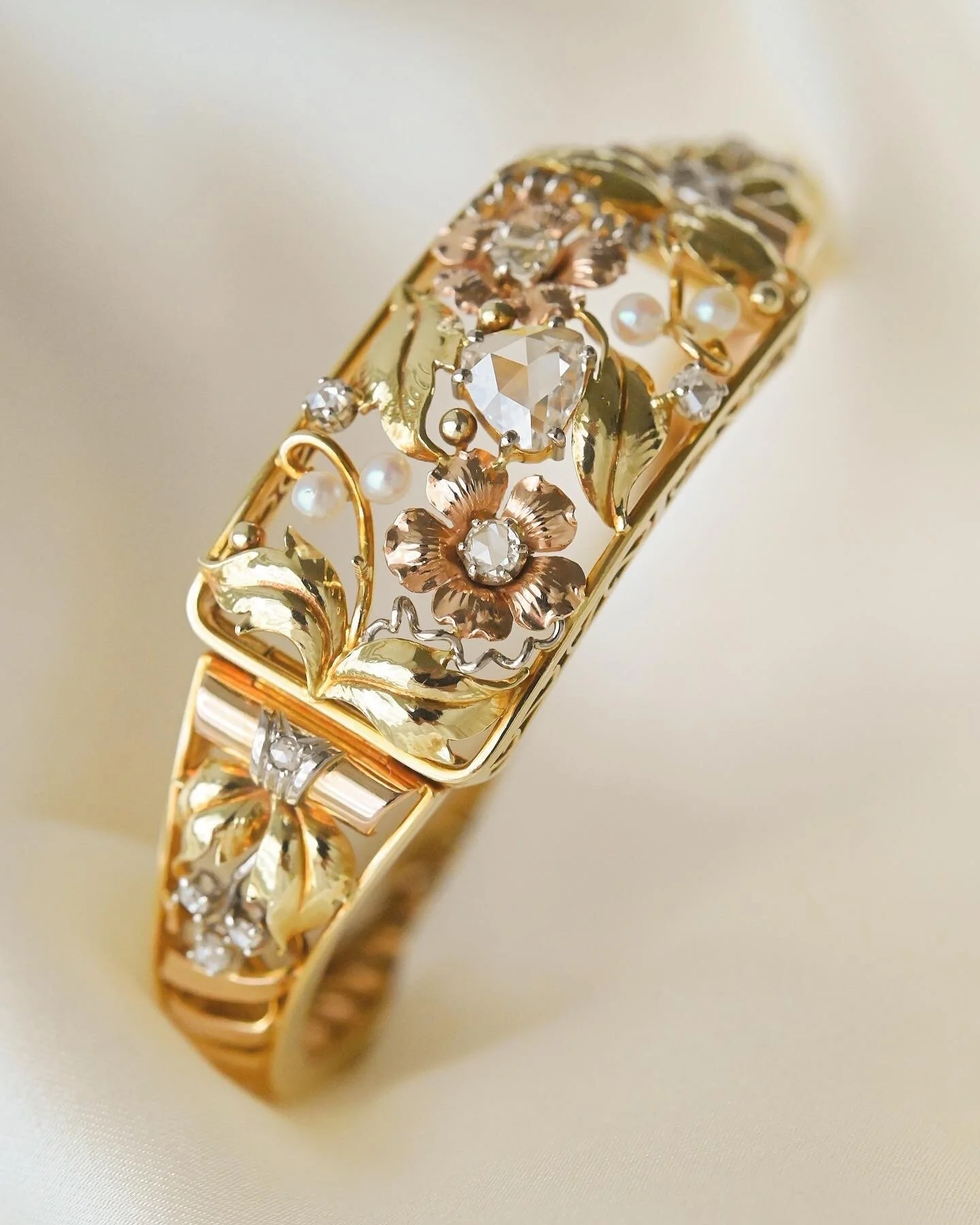
People send me photographs of inherited jewelry every week with the same question: how old is this?
You can get surprisingly far without any equipment at all. Jewelry is made of fashion, technology and materials, and all three change at datable moments. Once you know what changed and when, most pieces will tell you roughly when they were born.
Here is the way I actually work through a piece.
Step 1: Look at the back, not the front
Beginners look at the front. Dealers turn it over. The back of a piece is where the maker stopped performing and just did the work, and it is full of dates.
- Is the setting closed or open at the back? Closed backs, often with a foil behind the stone to make it brighter, generally mean pre-1850. Open backs, letting light through the stone, came in as stone cutting improved.
- How is it joined? Visible hand-file marks, slightly uneven solder and asymmetry mean handmade, which mostly means pre-1900. Uniform, sharp, repeated components mean machine-assisted manufacture.
- What are the findings like? Clasps, catches and earring fittings are the single most useful dating clue on the whole piece.
Step 2: Identify the metal
Metals arrive at datable moments.
- Platinum was not workable at scale until reliable high-temperature torches arrived around 1900. Platinum jewelry is essentially a twentieth century object. A "Victorian platinum ring" is almost always mislabelled.
- White gold was developed as a platinum substitute and became common from the 1920s.
- Silver-topped gold, where diamonds sit in silver settings backed with gold, is a classic Georgian and Victorian solution: silver was believed to make white stones look whiter, gold kept it from tarnishing the skin.
- Rose gold appears throughout, but a piece that is overwhelmingly rose gold, large and sculptural is usually Retro, from the 1935 to 1950 window.
- Base metal with rolled gold or gold filled marks places a piece in the mass-market production of roughly 1880 onward.
Step 3: Read the motifs
Every era had obsessions.
| Era | Dates | What you see |
|---|---|---|
| Georgian | c. 1714 to 1837 | Handmade, closed foiled settings, high-carat gold, rose and table cut stones, cannetille wirework, memorial pieces with hair |
| Early Victorian (Romantic) | 1837 to 1860 | Snakes, hearts, hands, seed pearls, coral, love and sentiment, engraved gold |
| Mid Victorian (Grand) | 1860 to 1885 | Mourning jewelry, jet, black enamel, onyx, heavy chains, lockets, archaeological revival with granulation |
| Late Victorian (Aesthetic) | 1885 to 1901 | Lighter and smaller, stars and crescents, bar brooches, diamonds in silver over gold |
| Art Nouveau | c. 1890 to 1910 | Flowing lines, women with long hair, insects, plique-a-jour enamel, opal, horn, moonstone |
| Edwardian | 1901 to 1915 | Platinum lace, milgrain edges, filigree, garlands and bows, pearls with diamonds, very white and airy |
| Art Deco | c. 1920 to 1935 | Geometry, symmetry, platinum, onyx and coral contrast, calibre-cut coloured stones, Egyptian and Asian influence |
| Retro | c. 1935 to 1950 | Big, sculptural, rose and yellow gold, ribbons, scrolls and bows, synthetic rubies, less platinum because of wartime restrictions |
Two common mix-ups worth naming. Art Nouveau and Art Deco overlap in the alphabet and nowhere else: Nouveau is curved, organic and asymmetric, Deco is straight, geometric and symmetrical. And Edwardian and Art Deco are both white and delicate, but Edwardian is soft, floral and lace-like, while Deco is architectural.
Step 4: Check the clasp and the fittings
This is where I get most of my confidence. Fittings were mass-produced, so they changed on a fairly tight timetable.
| Fitting | Roughly when | Note |
|---|---|---|
| C-clasp | Pre-1900 | A simple open hook, no safety. Very common on Victorian brooches |
| Pin extending past the body | Pre-c. 1910 | Made for thick Victorian fabric |
| Trombone clasp | c. 1850 to 1950 | A tube you pull out. Mostly Continental pieces |
| Safety catch | c. 1900 onward | Rotating cover. Widespread after roughly 1910 |
| Screw-back earrings | c. 1894 to 1950s | Made for unpierced ears |
| Clip-on earrings | c. 1930s onward | If it is a clip, it is not Victorian |
| Post and butterfly back | Twentieth century | Antique pierced earrings usually have a shepherd hook or French wire |
| Spring ring clasp | c. 1900 onward | |
| Lobster clasp | c. 1970s onward | On an "antique" chain it means a repair, or the piece is not antique |
A word of caution that saves people a lot of embarrassment: clasps get replaced. A modern clasp on an antique chain proves the clasp is modern, not the chain. Judge the clasp only when the rest of the piece agrees with it.
Step 5: Look at the stones
The way a stone is cut is a date stamp of its own.
- Table cuts and rose cuts point to Georgian and earlier Victorian work. A rose cut is flat-bottomed with a domed, faceted top, and it glows rather than sparkles.
- Old mine cuts, cushion-shaped with an open culet, run from the 1700s through to about 1900.
- Old European cuts, rounder with a small table, sit roughly 1890 to 1930.
- Calibre-cut coloured stones, tiny stones cut precisely to fill a channel, are a hallmark of Art Deco.
- Modern round brilliants in an otherwise antique piece almost always mean a later replacement.
Step 6: Only now, look for a hallmark
Hallmarks are the most reliable evidence when they exist, and they often do not. Many genuine Georgian and Victorian pieces were never marked, and marks wear away with a century of skin contact. Absence of a mark tells you almost nothing.
Where marks do exist, British marks with a date letter can date a piece to the exact year, and French, Danish, Russian and other national systems each have their own logic. That is a whole subject in itself, and I have written it up separately in the hallmarks guide.
Putting it together
No single clue decides it. You are building a case. A brooch with a C-clasp, a pin that overshoots the frame, a closed-back setting, a rose cut stone and a snake motif is not "probably Victorian", it is Victorian, and early Victorian at that, because five independent clues agree.
When the clues disagree, believe the most conservative one, and consider that the piece may have been altered. Most antique jewelry has been repaired, resized, re-clasped or re-stoned at least once. That is not damage. That is a hundred and fifty years of being loved.
Questions people ask
What is the difference between antique and vintage jewelry?
Antique generally means at least 100 years old. Vintage usually means at least 20 to 30 years old but under 100. A 1920s Art Deco ring is now antique. A 1970s gold chain is vintage.
How can I tell if my jewelry is Victorian?
Victorian spans 1837 to 1901, so look for handmade construction, a C-clasp or long pin on brooches, closed-back or silver-topped gold settings, rose or old mine cut stones, and sentimental motifs like hearts, snakes, hands and lockets.
Does a hallmark prove my jewelry is old?
It proves the metal standard and, in some countries, the year and city of assay. It does not prove the whole piece is original, since marks can survive alterations. And plenty of genuinely old jewelry carries no mark at all.
Can I date jewelry from a photograph?
Partly. A clear photograph of the back, the clasp and the side profile will usually get you to within one era. Front-only photographs are the hardest to judge, which is why every listing in my shop shows the back.
Have a piece you cannot place? I love these puzzles. And if you are looking for a specific era, the shop is sorted so you can browse by period, or you can post what you are hunting for on Nextmine.
Line Evelin