
What Is an Old Mine Cut Diamond? A Collector’s Guide
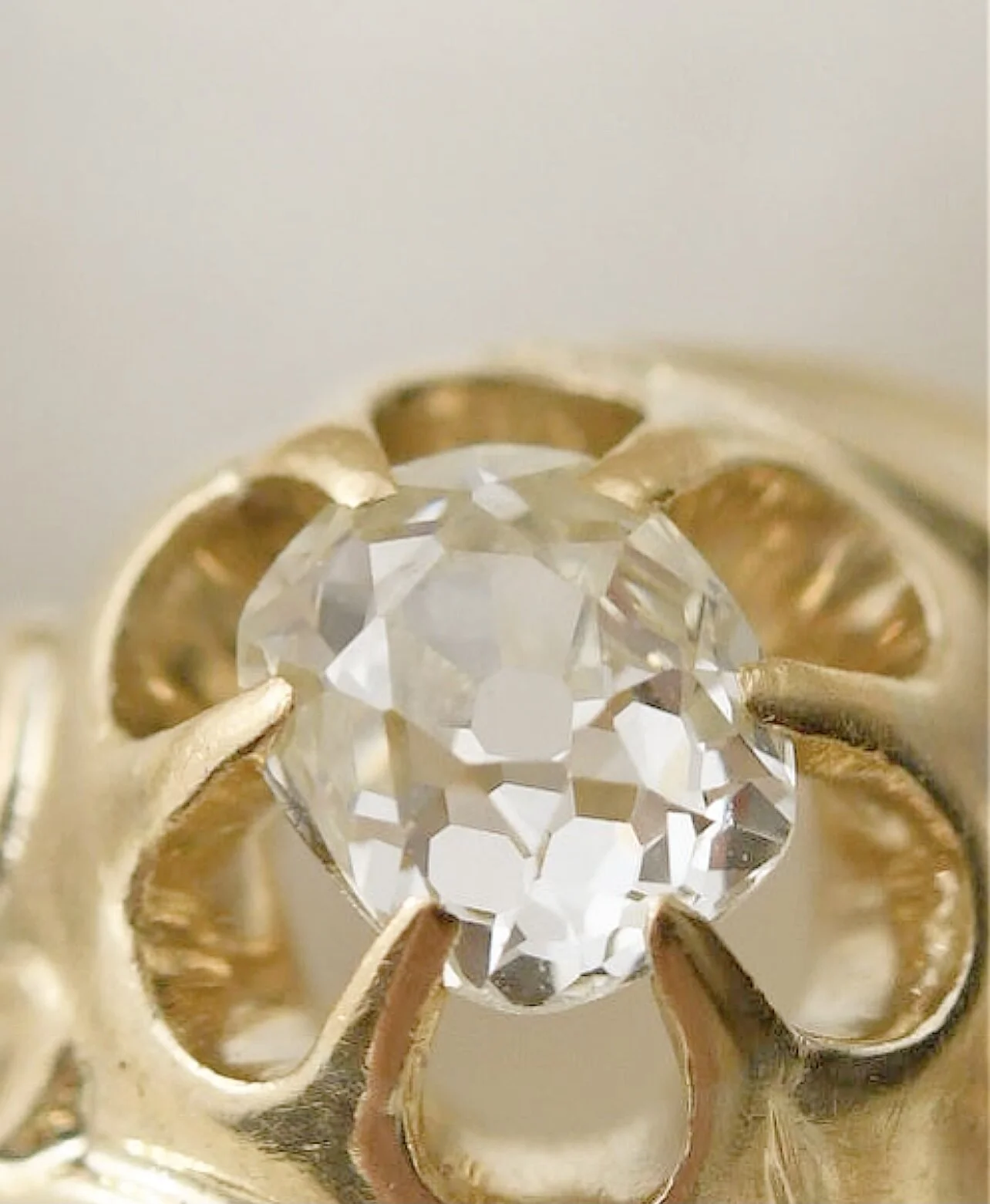
Our name is not an accident. An old mine cut diamond is the reason I fell in love with antique jewelry in the first place, and it is still the thing I look for before anything else when I am buying.
If you have ever looked at an antique ring and thought the stone looked softer, warmer and somehow more alive than a modern diamond, you were probably looking at one.
What is an old mine cut diamond?
An old mine cut is a hand-cut diamond, made roughly between the early 1700s and the early 1900s, with a squarish or cushion-shaped outline, a small flat table, a tall crown, a deep body and an open culet at the bottom. It is the earliest form of the brilliant cut, and it was cut entirely by eye, by hand, long before machines and light-performance mathematics existed.
The name comes from the "old mines": the diamond fields of India and Brazil that supplied Europe before the great South African finds of the late 1800s. When those newer mines opened, the older material became "old mine" goods, and the name stuck to the cutting style too.
How to identify an old mine cut diamond
You do not need a loupe for most of these. Hold the stone face-up in daylight and look for:
A cushion or squarish outline. Rarely a perfect circle. The girdle often wobbles slightly, because it was shaped against another diamond by hand.
A small table. The flat facet on top is noticeably smaller in proportion than on a modern stone.
A high crown. The stone sits tall in its setting. From the side it looks like a little pyramid rather than a flat disc.
An open culet. This is the giveaway. Look straight down through the table and you will often see a small dot, circle or "hole" at the bottom. That is the culet, deliberately left flat rather than closed to a point.
Facets that do not quite match. Slight asymmetry is normal and, to a collector, desirable. It is the fingerprint of the person who cut it.
Warm, broad flashes. Old mine cuts throw large, slow, chunky flashes of light and fire rather than the fast white pinpoint sparkle of a modern brilliant.
If a stone ticks four or more of these, you are almost certainly looking at an old mine cut.
Old mine cut vs old European cut vs modern brilliant
These three get confused constantly, so here they are side by side.
| Old mine cut | Old European cut | Modern round brilliant | |
|---|---|---|---|
| Roughly when | c. 1700 to c. 1900 | c. 1890 to c. 1930 | c. 1920 to today |
| Outline | Cushion or squarish, uneven | Round, but hand-rounded | Perfectly round, machine-precise |
| Table | Small | Small to medium | Large |
| Crown | Tall | Tall | Shallow |
| Culet | Open, often large | Open, usually smaller | Closed to a point |
| How it was made | Cut by eye, by hand | Bruted on early machinery | Cut to calculated proportions |
| Light behaviour | Broad, warm, fiery flashes | Fire with more brightness | Bright, fast white sparkle |
| Cut to | Save weight from the rough | Save weight, add symmetry | Maximise light return |
The short version: old mine cuts were cut to keep as much of the original crystal as possible. Modern diamonds are cut to throw as much light back at you as possible. Neither is better. They are answering different questions.
Why old mine cuts look different in real life
Old mine cuts were cut for candlelight and oil lamps. A small number of large facets catches a single small light source and returns it as a broad flash of colour. Under a modern ceiling spotlight, the same stone can look quieter than a new diamond, and some people are briefly disappointed.
Then they take it outside, or light a candle, or sit near a window at four in the afternoon, and they understand. The stone breathes. It goes from grey to gold to a flash of pink, then back again. Modern brilliants are consistent. Old mine cuts have moods.
Are old mine cut diamonds worth more?
It depends on what you mean by worth, and this is where I want to be honest rather than salesy.
- On paper, graded against modern standards, they often score worse. Certification systems reward symmetry, proportion and light return, all of which are exactly what an old mine cut was not trying to achieve. A modern lab report can make a beautiful antique stone look mediocre.
- In the collector market, good ones have been climbing for years. The supply is fixed and shrinking, because for most of the twentieth century old mine cuts were routinely recut into modern shapes. Every stone that got recut is gone forever.
- Per carat, they are frequently still cheaper than a modern stone of the same weight with similar colour and clarity, which is why so many people end up buying a bigger, older, more interesting diamond for the same budget.
So: worth more than a modern brilliant? Not automatically. Worth more than they were ten years ago, and unlikely to become more common? Yes.
What to check before you buy an antique diamond
- Look at the stone under several kinds of light, including daylight and a single warm light. Photographs under a jeweller's lamp tell you very little about how a stone lives on a hand.
- Ask about chips on the girdle and culet. Antique stones have thin girdles and open culets, and small chips are common. A tiny one, hidden in a setting, is usually not a problem. Ask, and ask for a photograph.
- Check whether the stone is original to the setting. A Victorian ring with a modern stone dropped in later is a different object, and a different price.
- Do not expect certification. Most antique stones are unpapered, and pulling a stone out of a hundred-year-old setting to send it to a lab risks damaging the mount. Buy from someone who describes honestly instead.
- Buy the stone, not the paperwork. With old cuts, your eye is the better instrument.
Questions people ask
Is an old mine cut the same as a cushion cut?
No. A modern cushion cut is a contemporary stone cut with rounded corners and modern proportions. An old mine cut is antique, hand-cut, with a small table, a tall crown and an open culet. They can look similar in a thumbnail photograph and nothing alike in person.
Do all old mine cuts have an open culet?
Almost all do, though the size varies from a pinprick to a clear circle. A completely closed culet on an otherwise antique-looking stone is a reason to look more carefully.
Can I have an old mine cut recut to sparkle more?
You can, and please do not. You would lose weight, lose the character, and permanently destroy something that cannot be replaced. If you want modern sparkle, buy a modern stone and keep the antique as it is.
Are old mine cut diamonds a good investment?
They hold value better than mass-market modern jewelry, mainly because supply is finite. But buy one because you want to wear it. Jewelry that you love and wear every day has already paid for itself.
Where can I buy an old mine cut diamond?
Antique dealers, auctions, estate sales, and specialist shops like ours. If you are buying online, buy from someone who shows the culet, shows the side profile, and tells you about the chips.
If you are hunting for a particular era or a particular stone, come and look at what is in the shop right now. And if a piece you love has already sold, you can post it as a request on Nextmine, where collectors sell their own pieces on to each other.
If you want to place a piece in its period, I have also written a guide to dating antique jewelry.
Line Evelin